
 BIP
BIP
Productivity growth is driving the development of Polish cities. Wroclaw is among them

Polish cities have been among the fastest-growing in Europe over the past 25 years, according to a report by Oxford Economics. Economists at the consulting firm, which specializes in economic forecasts and analyses, also predict that Warsaw—along with Kraków, Wrocław, and Gdańsk—will remain among the continent’s leaders in GDP growth this decade.
Looking at the summary of the last quarter-century since 2000 compiled by Oxford Economics analysts, it is clear that cities in Central and Eastern Europe have dominated economic growth across the entire continent during this period. Poland’s major metropolitan areas accounted for a significant portion of the fastest-growing cities in Europe, outpacing giants such as London, Amsterdam, and Madrid.
This success was driven by several key trends: the growing dominance of the service sector in metropolitan economies, a shift in production toward higher value-added activities, integration into key pan-European supply chains, and a significant increase in foreign direct investment (FDI).
Polish cities outpaced most of Europe
Since the turn of the 20th and 21st centuries, Poland’s largest cities have grown by an average of 4.0 percent annually. During this time, the average for European cities was just 2.1 percent. Kraków performed best in this regard, growing by 4.2 percent during the period in question. Warsaw was close behind, followed by Gdańsk and Wrocław. In contrast, Poznań and Łódź brought up the rear among Polish cities.
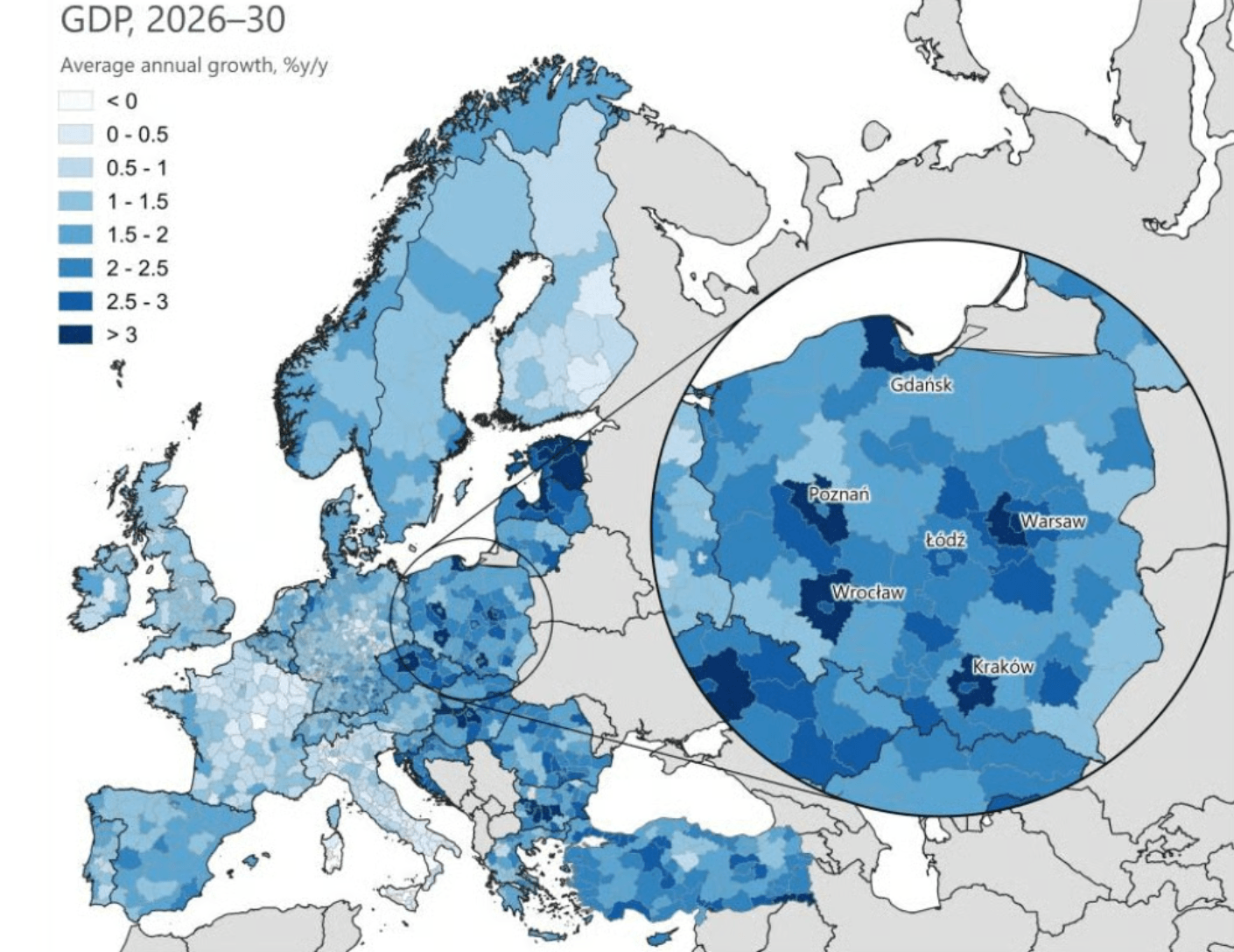
It should be noted, however, that these five Polish cities outperformed most of those in Western Europe. The only exception is Dublin, which, with a growth rate of over 5 percent, tops the ranking prepared by Oxford Economics. Among the metropolitan areas in Central and Eastern Europe, only Sofia and Bucharest outperformed the Polish cities.
Excellent Forecasts Through the End of the Decade
Equally important, Oxford Economics estimates that our urban centers will continue to maintain a strong pace of growth. However, a change in the leader among Polish metropolitan areas is expected—in the medium term, according to analysts, Warsaw will take the lead thanks to its larger services sector. Nevertheless, Wrocław and Gdańsk should keep pace with the capital over the next five years, according to Oxford Economics.
According to the consulting firm’s calculations, Wrocław will be among the five Polish cities (along with Warsaw, Kraków, Gdańsk, and Poznań) that will achieve an average annual GDP growth rate of over 3 percent between 2026 and 2030.
In the long term—by 2050—Warsaw is expected to surpass Lyon, Vienna, and Helsinki in terms of economic size.
From the automotive industry to a battery factory and a new technology park
Oxford Economics also highlights the reasons behind such dynamic growth in Poland’s five major urban centers. Industry was one of the key factors, though not the only one.
The manufacturing sector laid the groundwork for strong growth, but it was the information and communications technology (ICT) sector, finance, and business services that drove productivity gains and propelled the economies of Poland’s major cities to the top of European rankings.
Central Europe benefited from companies diversifying their supply chains and moving production closer to suppliers (nearshoring), prioritizing resilience over costs alone. This enabled European manufacturers to shorten order fulfillment times and reduce geopolitical risk while taking advantage of Poland’s competitive and highly skilled workforce - according to an analysis by Oxford Economics.
Poland’s EU membership certainly played a major role in this, accelerating our country’s advancement in the value chain. Manufacturing has shifted from exporting raw materials to producing intermediate goods (e.g., auto parts and specialized machinery). Polish industry will continue to evolve toward more specialized, higher-margin products.
An excellent example is the country’s ability to capitalize on the opportunities presented by the global transition to clean energy and the decarbonization of transportation. This has led to increased demand for electric vehicles, as well as investments in batteries and components for their production. Wrocław has benefited particularly from this—the Wrocław region is home to Europe’s largest lithium-ion battery factory, operated by the South Korean company LG Energy Solution.
And this is by no means the last major investment to be established near the capital of Lower Silesia. The Taiwanese company TEEMA plans to build a Technology Park near Wrocław—in Miękinia.
It will be one of the largest centers for new technologies in Europe.